Nonogram Strategy: Step-by-Step Guide to Solving Puzzles
Nonogram is a fascinating logic puzzle game. This article will teach you how to use logic and techniques to solve puzzles step by step through illustrated examples.
Let's start with a simple 5×5 puzzle.
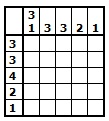
Tip: Throughout this guide, C stands for Column (e.g., C1 means Column 1 from the left), and R stands for Row (e.g., R1 means Row 1 from the top).
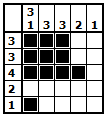
We should always start from the easiest places. It's easy to see that Column 1 (C1) has only one valid way to fill.
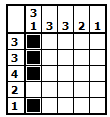
Now Row 5 (R5) is also full. Looking at R1 and R2, since they require a block of length 3, and the starting point is given, it can only extend in one direction.
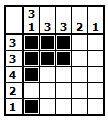
The same logic applies to C2 and C3.
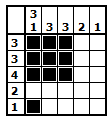
We also need to fill R3.
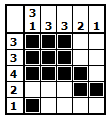
At this point, R4, C4, and C5 are still empty, and we can't get the answer immediately from their clues. However, since R1, R2, R3, R5, C1, C2, and C3 are filled, the cells we fill in R4, C4, C5 must not intersect with the empty spaces of those lines. This makes it easy to get the final result:
Advanced Difficulty
Now let's increase the difficulty:
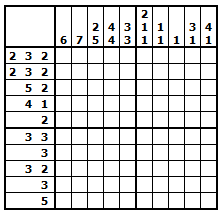
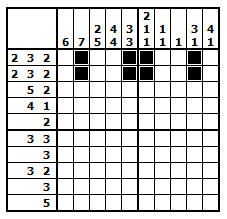
First, R1 and R2 are the easiest to start with. The filling isn't unique, but obviously, some squares are mandatory in all possible configurations:
Next, C2 can be completely determined, and C5, C6, C9 can be partially determined. Also, R8C2, R4C5, R3C6, R4C9 definitely cannot be filled:
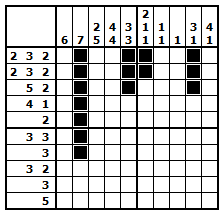
Using the condition that R4C5 and R3C6 cannot be filled, we get:
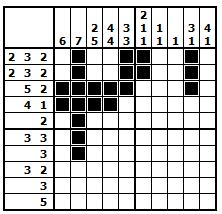
At this time, C3 already has a block of length 2, so the remaining filling is unique:
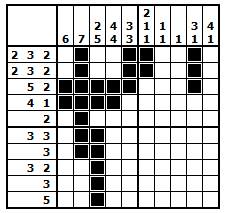
Since C3 cannot have any other squares filled, the first length 2 block of R1 and R2 is also determined:
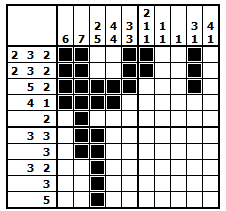
C1 is determined, and the first part of R5 and R6 is also determined:
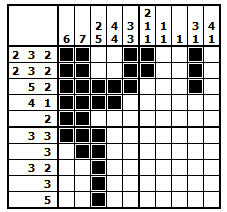
R7, C4 are determined (note that R5C4 and R6C4 cannot be filled):
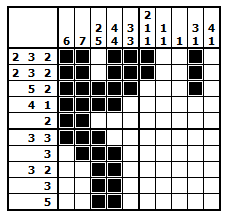
Determine R9, C5:
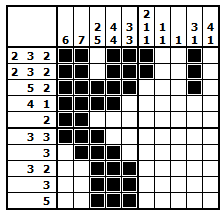
R10 is determined:
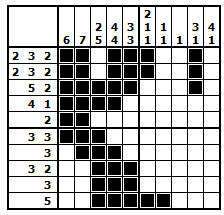
For R1, R2, it's obvious that C8 can only contain a block of length 1. Thus we can deduce:
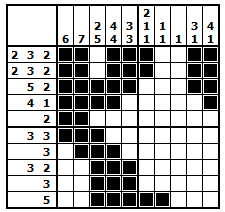
Now R1R5, C1C5 are all determined, and the rest is very easy to solve:
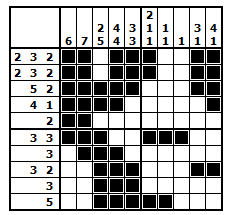
The final answer:
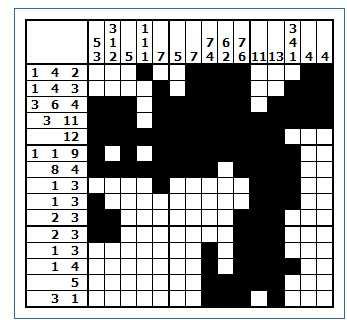
Core Nonogram Principles
The rules of Nonogram: The game board is a square grid where each cell must eventually be painted black or marked with an X. The goal is to find all the black cells.
Let's discuss the conditions under which an empty cell can be painted black.
1. Border Overlap Method
Every row or column has two extreme boundary ways of filling (packing blocks as tightly as possible to one end). When these two extreme fillings overlap, the overlapping region must be black.
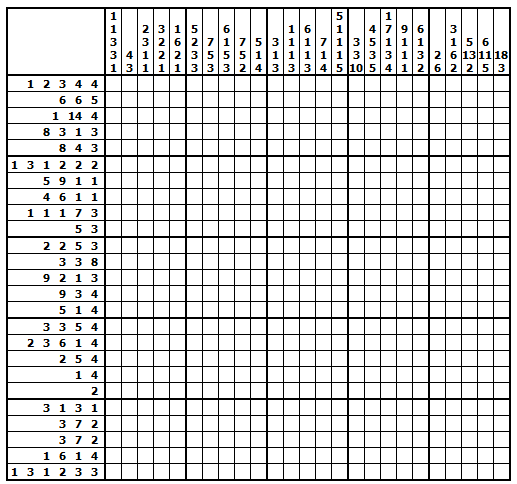
Consider C25. There are two ways to pack the blocks: either as high up as possible or as low down as possible:
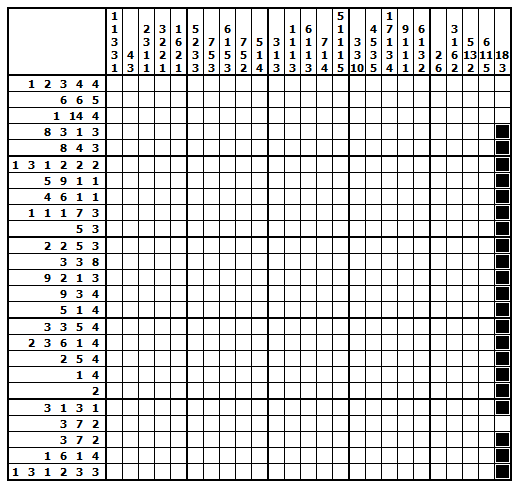
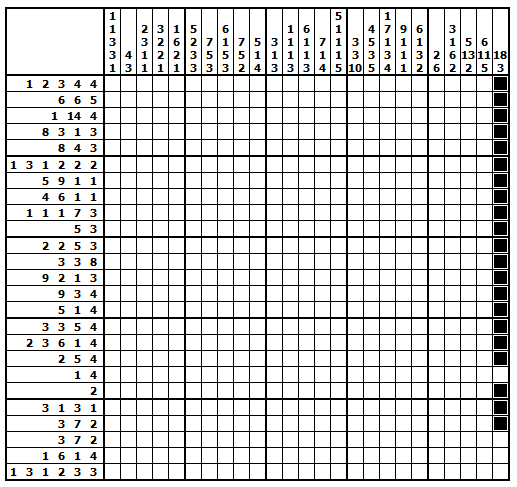
We can easily identify the overlapping regions for the two blocks of length 10:
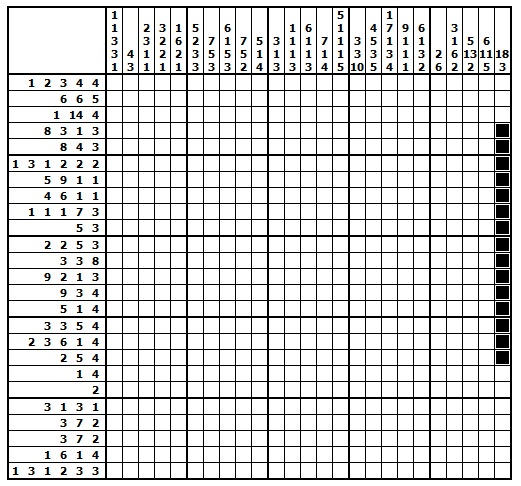
This gives us guaranteed filled squares.
2. Starting Point Extension
If the starting point of a certain length is given, the region extending from the starting point up to the length is black.
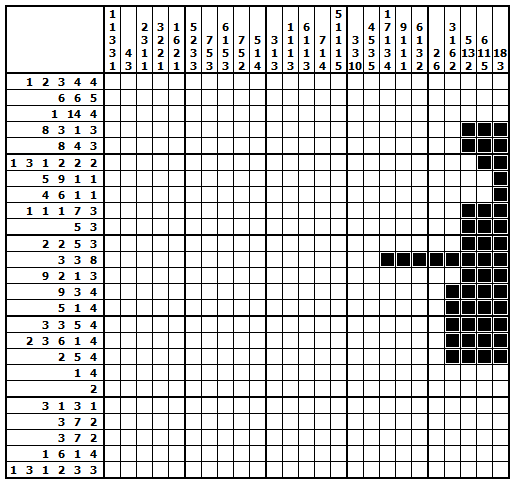
3. Closure and Exclusion
If a certain block length is fully determined, its two ends must be marked with an X.
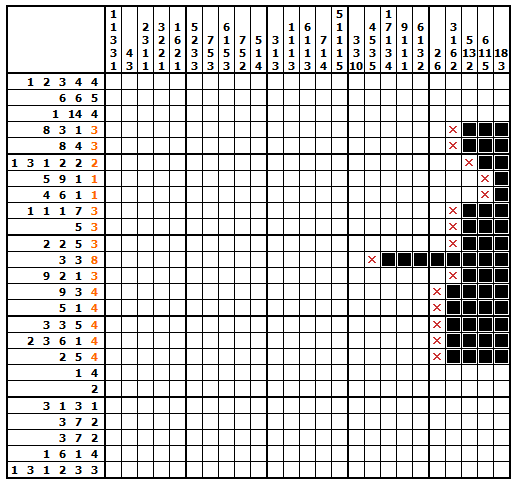
Repeating these three basic methods gives us this state:
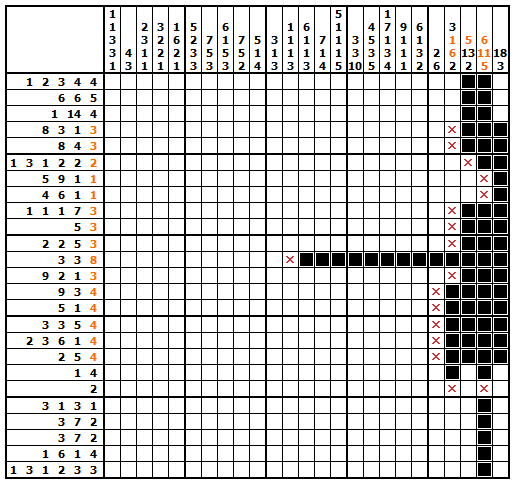
Core Strategy: Constraints
The overarching logic running through all methods is the concept of "constraints." A horizontal axis (or vertical) will inevitably be constrained by the other axis, limiting certain lengths to specific ranges.
Let's look at R1. C23 and C24 have provided their first blocks, both crossing R1. It is logical to deduce that R1C23 and R1C24 must be part of the final block of R1.
If we use the leftmost R1C23 as the starting point, it hits the border before reaching length 4, which is wrong. Therefore, to make this boundary case correct, the starting point must be at least R1C22:
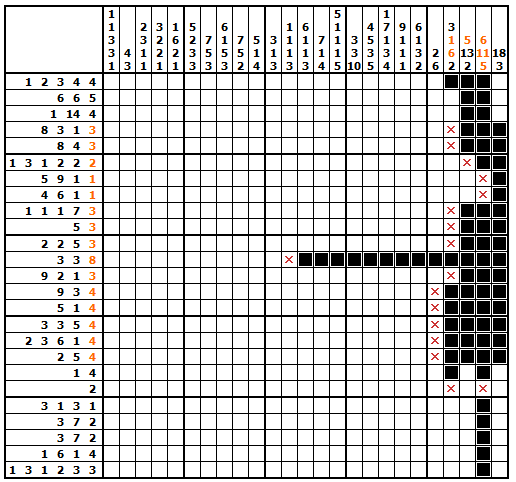
The same logic applies to R2, R3, R24, R25:
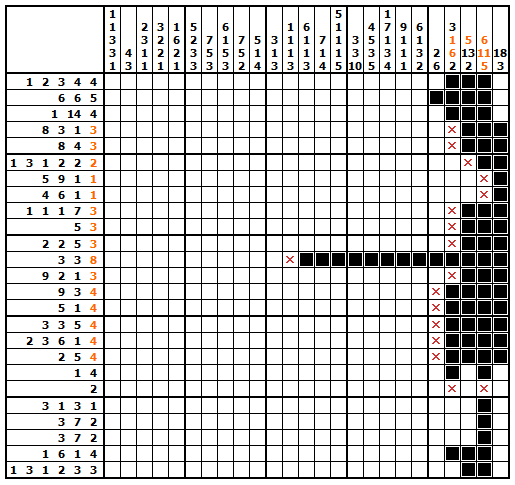
Due to constraints, newly filled black cells or X cells will impact the other axis, yielding this result:
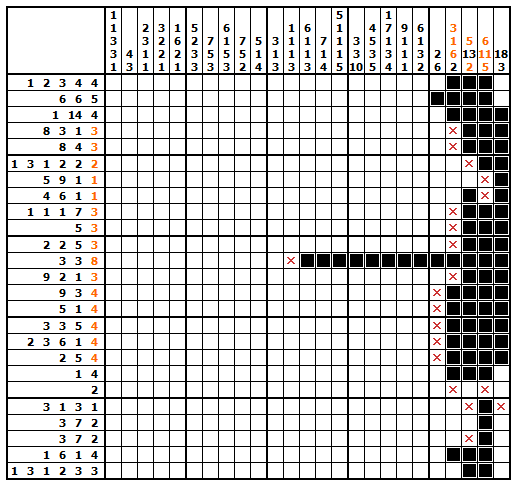
Now let's discuss the case where an area is constrained by two X cells. In C25, R21 to R25 is constrained by an X cell and the border. If this empty segment contains a block, it must be the length 3 block. We can then apply the overlap method to find guaranteed cells:
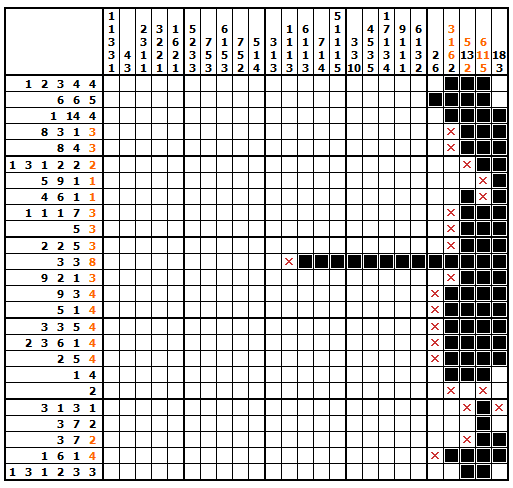
Similarly, R22C23 is constrained by two X cells, but since C23 has no length 1 block, it cannot contain any block:
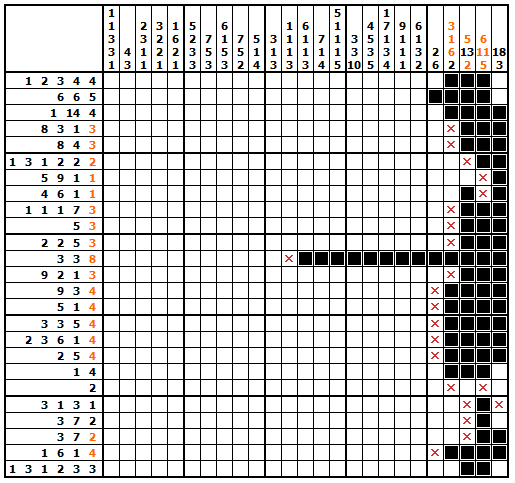
After some patching up:
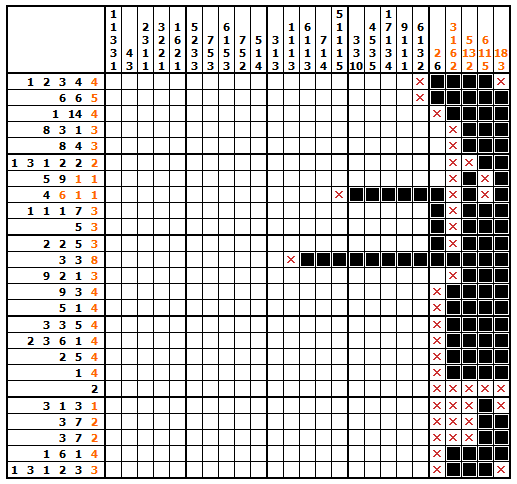
More Advanced Examples and Deductions
Let's use a new puzzle for further discussion.
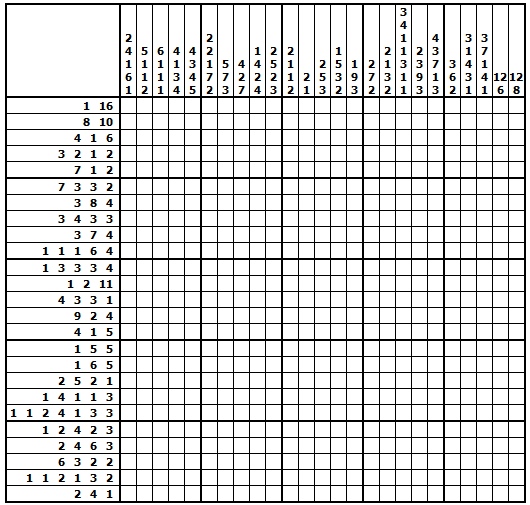
Repeating the previous techniques, we get:
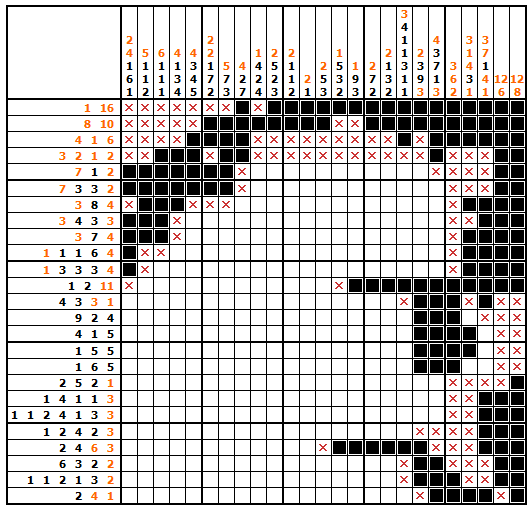
Let's look at C15, which contains blocks of 1, 9, and 3. For the final length 3, its possible range is constrained between R19 and R24. Therefore, R25C15 can never be reached and must be an X:
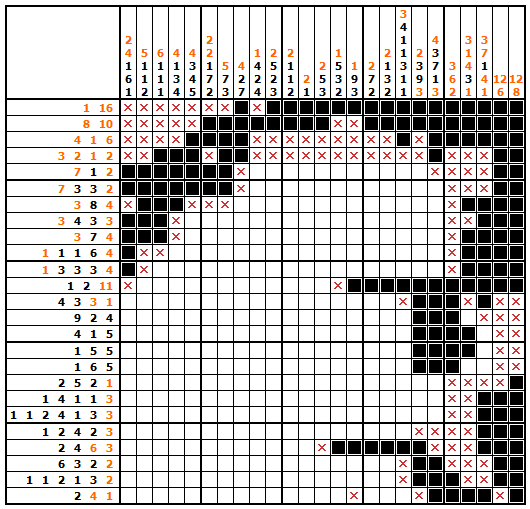
Applying this again:
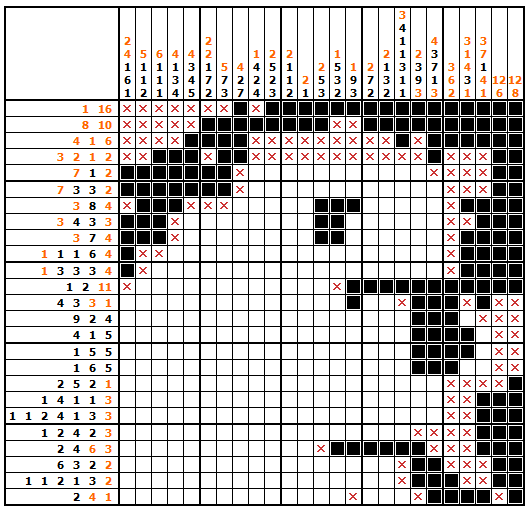
For R9, lengths 3 and 4 are determined, and length 7 is constrained to the two middle black cells. No matter how length 7 extends, there are unreachable areas, so:
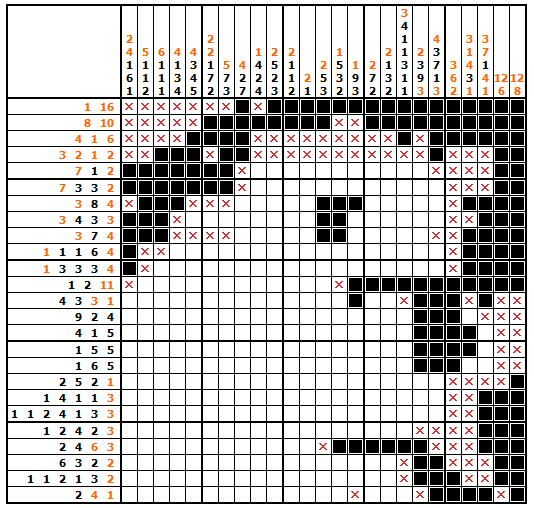
Now let's discuss white cells surrounded by black cells. There are two possibilities: they can either be connected or separated by an X.
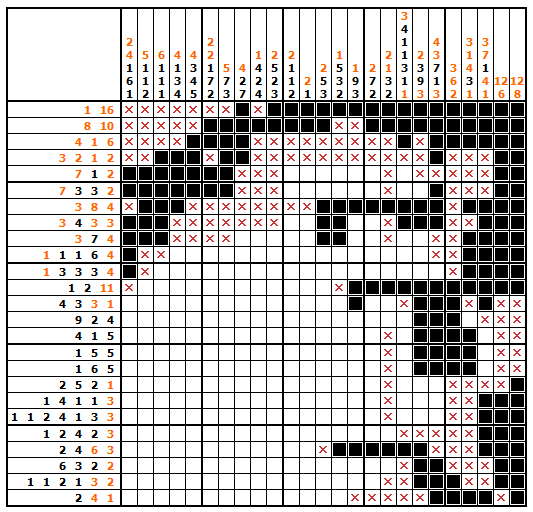
In C15, for R7C15 and R12C15/R13C15, if they were connected, the length would be less than 9. But we know R7C15 belongs to length 9, so they must be connected. Similarly, R13C15 cannot connect to R22C15, because R22C15 belongs to length 3.
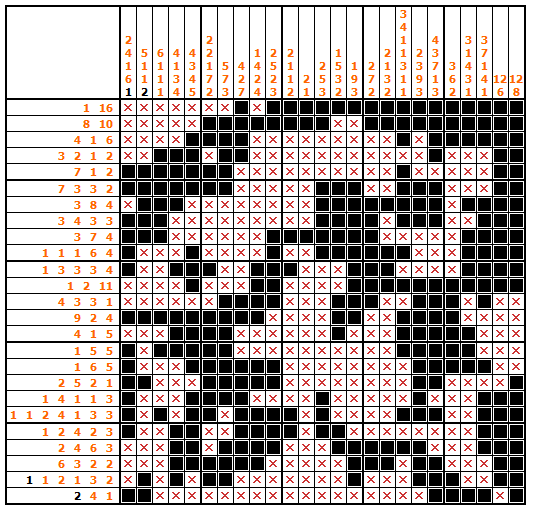
By applying these advanced techniques systematically, we arrive at the final solution!
Puzzle PK Team
The Puzzle PK Team is a group of puzzle enthusiasts crafting free, high-quality logic games and brain-training guides for players of all ages. Got feedback or ideas? We would love to hear from you.
More about Puzzle PK